Alchemy
Alchemy is the most significant, and most powerful, form of magic in the Drehmal universe. Many important figures from Drehmal's history were alchemists, and alchemy broadly reflects the technological progress of the Drehmari.
All alchemy is done in pursuit of a singular, lofty goal: completion of the Great Work. The Great Work is commonly defined as the harnessing and full usage of divine magic by a mortal: effectively, apotheosis.
Alchemy in Drehmal is very heavily inspired by real-world alchemy, an early form of science concerned with the transmutation of metals, development of universal cures, and the perfection of the human form through a magnum opus, or a 'great work'. It also draws significantly from Gnosticism.
Origins
Alchemy as it is known in modern Drehmal originated in Ancehl Castle in the early-mid Second Avihm, although it did have earlier practitioners such as Aok. An alchemist named Otahnes Magian was the first to develop a conceptual school of Alchemy, in Av2 1320. This school, known as Asomatous Alchemy, was heavily focused on the Doctrine of Spheres.
More formal schools of thought would emerge over time, centered around Akhlo'Rohma and Avsohm in late Av2.
Practices and Culture
Alchemists are notorious for their relentless, single-minded pursuit of the Great Work, being very well known to attempt this by any means necessary. The actual work of an alchemist varies based on their specialty and particular situation.
Fundamentally, alchemy can be considered a form of arcanism, Drehmal's magic system which utilizes magical runes to interact with fire, water, air, and other such natural/fundamental forces. Alchemy is known to some arcanists as "biomancy", a school of arcanism which strictly seeks to use and manipulate organic matter. Due to the inherent complexity of living things, this makes alchemy much more complicated than arcanism, and alchemists consider it an insult to be compared to arcanists. Alchemists are generally considered to be much more studious and well-learned than their arcane counterparts, as the path to the Great Work is much more spiritually and intellectually demanding than learning basic arcanism.
There are multiple schools and sects of alchemy, which each emphasize different parts of the field. (1) Some would argue that the schools of alchemy are revisionist history on the part of Avsohm, unnecessarily dividing that which is fundamentally all the same.
- These schools, particularly the Asomatous school, are mentioned in several sources, but Introduction to Alchemy gives the clearest outline of Avsohm's alchemical schools of thought.
Asomatous Alchemy
The first formal school of alchemy to develop in Av2 was Asomatous Alchemy in Av2 1320. This field focuses heavily on the Doctrine of Spheres, a concept tied to the Celestial Bodies of the realm. Each of the 4 moons and the Torahn are considered one of these "Spheres", and alchemists attempt to conquer the Spheres by astrally projecting to them. The Spheres are attempted in a set order, and very few have ever made it beyond three or four.
The Doctrine of Spheres emphasizes the spiritual journey to the Great Work. Conquering the fifth Sphere is not the Great Work in itself, but it does seem to signify that one is powerful enough to do so. There are also whispers of a hidden sixth sphere, not within the realm of Drehmal, which has only been seen by a select few.
Asomatous alchemy is the widely held position of Red Dawn alchemists.
Hermetic Alchemy
The second major school of alchemy, Hermetic Alchemy developed in the late Av2 1300s, closely following Asomatous Alchemy. Hermetic alchemy is closer to real-life alchemy as an early progenitor to chemistry, focused more on potion mixing and the studying of alchemy as a hard science.
Metamorphic/Bionic Alchemy
The third school, particularly prevalent in Avsohm, was Metamorphic Alchemy, which focused on applying Hermetic alchemy to directly modify the body. Under Avsohm, this included the use of rehntite implants, and advanced practitioners were considered nearly invincible.
Practical Biomechanics
Practical Biomechanics is an alchemical style, pulling from Hermeticism, which was very popular and widely taught in Avsohm. This field focused on the manipulation of organic material such as wood in order to make it better for Drehmari life, creating strong materials through magical manipulation.
Skeveraan
The Skeveraan are a small sect of Bionic Alchemists who create Frankenstein-esque monsters by stitching together multiple different creatures, reviled by less radical alchemists and whose work is seen as trivial by more traditional practitioners.
Great Work
The Great Work is the goal of any self-respecting alchemist, defined as the harnessing of Divine Magic by a mortal, effectively making them into an immortal god themselves. This can be achieved in any number of ways, as The Great Work states:
Little is known about the Great Work, and there are only two facts upon which most Alchemists agree:
1) As an extension of their being, the Great Work is unique to every alchemist.
2) There are only two known completions of the Great Work, the First Necromancer and the Lord of Dust.
Many have attempted the Great Work, and some have even come close, but only two are known to have completed it: Aok, the First Necromancer, and Akim, the Lord of Dust. Both figures are extremely mysterious.
The Great Work is almost certainly derived from the concept of the Great Work (magnum opus) in the historical field of alchemy, a similar kind of perfection of the human body.
Aok, The First Necromancer
Aok's Great Work is shrouded in mystery. The inventor of necromancy, Aok lived in the ancient First Avihm, in a world that would be wholly unfamiliar to modern Drehmari, and his true actions are not known. However, it is stated that he was able to cross through the Veil, and he clearly served as a strong inspiration for the Tri-Moon Theocracy some 1500 years later.
Akim, Lord of Dust
There are only two clear references to Akim in the map: the passage above and the Dusty Tome in Teiruun Monastery, written by Akim. Akim's particular specialty is even less clear than Aok's, as "Lord of Dust" does not seem to directly coincide with any known field of magic.
Akim's book references Aok's Great Work, establishing that Aok came first. The book is found at a structure that has only existed since mid-Av2 and Akim references Asomatous alchemy, which was only invented in Av2 1320. Therefore, Akim can likely be assumed to have completed his Great Work no earlier than the mid-late Second Avihm.
Attempted Great Works
There have been many others who attempted to carry out the Great Work, and came close enough to be remembered by history.
Klyhf Him'lahk, the Defiler
Klyhf Him'lahk was a Red Dawn alchemist who defected to the legions of Maelihs shortly after the Fall of Avsohm, and the best-documented alchemist to fail at the Great Work. Klyhf came to the conclusion that the Great Work was only possible through a massive transfer of power from an existing divine being into the alchemist, and settled on Mael as his target. Slowly befriending the Burnt Lord over the course of over a decade, Klyhf eventually attempted to sacrifice Maelihs in a machine that would grant him apotheosis. It appears from the records at the Burnt Palace that Mael realized this scheme as it was happening, and killed Klyhf in a brutal rage.
Hish of the Rising Smoke
One of three alchemists named in The Great Work as having nearly completed the Work. No other references to this character are known to exist in the map.
Jabim, the Broken Thing
One of three alchemists named in The Great Work as having nearly completed the Work. No other references to this character are known to exist in the map.
Ehzar Gohman
Ehzar Gohman is a living alchemist in Ancehl Castle, having recently overthrown Duke Duruis of Ancehl and appointing himself the Regent. Believing himself to have extremely low potentia, Ehzar has resorted to secretly consuming the fingernails and hair of the high-potentia child Duchess, writing that he will one day grow large enough to consume entire towns.
Tri-Moon Theocracy
The Tri-Moon Theocracy was a state of necromancers living in Lorahn'Kahl in mid-late Av2. Led by an alchemist named Saint Raene, they seem to have been heavily inspired by Aok, and constructed the Moonlight Sanctum in an attempt at the Great Work. This construction, a necrotic engine, was intended to harvest colossal amounts of Primal Energy through the repeated killing and resurrection of a few people. It is unclear why it failed, and this may have simply been because of the Theocracy's collapse at the hands of Avsohm.
Red Dawn/Avsohm
This Great Work attempt is a massive end-game spoiler!
Avsohm's Great Work
Working as part of the Avsohmic government, Red Dawn made their own collaborative attempt at the Great Work in the annals of Azimuth Labs. This Great Work was known as the God Machine, a massive device built to ascend Emperor Anyr into a god. It failed, likely due to outside interference.
Ambition
This section draws from many late-game sources. Out of context, they may not be considered true story spoilers, but keep reading at your own discretion. Following links in this section will take you to very late-game spoilers.
The Ambition is an extremely obscure final alchemical act beyond even the Great Work, referenced very sparingly.
The Ambition is not well defined, and has been theorized by community members to involve challenging the strongest being in the universe. There is no clear evidence for or against this statement.
The Ambition is mentioned in this format (capitalized as a named act) only twice.
The Codex Celestus, even in its damaged version, contains the full word "Ambition" in this format, with the community reconstruction of that full sentence reading:
Though I dare not even speak his name, he once while mortal used runic magic and the work of my children to invoke the ultimate act of Ambition.
The other mention is in the Null Greaves in the Primary Energy Collection Facility, whose lore description quite simply reads:
The Ambition is already complete.
The former source is believed to be Khive writing about Aok, suggesting that the First Necromancer also attempted the Ambition.
The Ambition is widely believed to be tied to the secret sixth sphere (1) mentioned by Akim in the Dusty Tome, as the final step beyond the Great Work revealed to those who have reached it. Akim ends this book by stating "my ambition knows no bounds", strongly suggesting that he attempted the Ambition.
- Described as a "swirling vortex of yellow and purple, devouring all that stray near it", almost certainly the Heart of the Void.
The Facets have also been speculated to reflect possible realities in which different characters complete the Ambition, with Facet I seeming to be connected to Aok and predicting that he would raise an army of the dead to "fuel his ambition".
Eidolic Whispers
 You feel an arcane presence...
This page or section may contain significant spoilers for Drehmal: Apotheosis. Read the additional messages below for specific spoiler information.
WARNING!!! This article/section contains EXTREMELY SIGNIFICANT spoilers for end-game areas (after the Mt. Yavhlix sequence).
If you have not FINISHED THE MAIN STORY OF THE MAP IN ITS ENTIRETY, we strongly recommend that you DO NOT read the contents of this article.
Note: The true end of the storyline will take you to a dedicated credits room, NOT the vanilla Minecraft end credits.
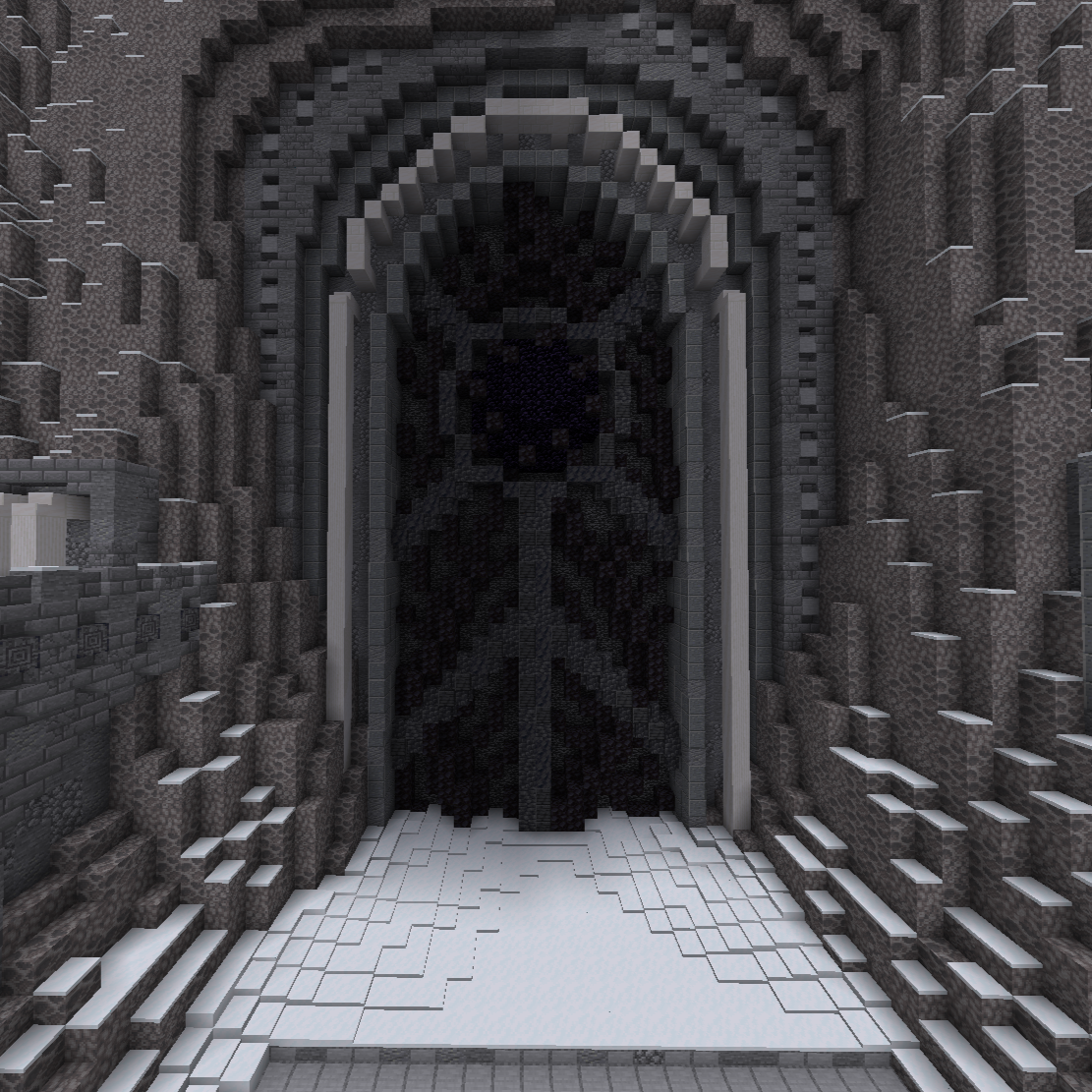
Throughout the map, there are scattered references to "eidolic" whispers, or other forms of the word "eidolon":
| Item | Associated Lore Text |
|---|---|
| Ascendance | Deep within the flooded caverns of Lorahn'Kahl lies the Moonlight Sanctum, the crux of the Tri-Moon Theocracy's greater machinations. As said by the eidolic whispers, the sanctum was designed to create an endless necromantic loop. This blade was part of that cycle, having killed millions of undead souls. To what ambitious end the sanctum served was known only by its creators. |
| Eidolon's Gamble (Artifact) | Thousands were chosen. None have succeeded. |
| Maw (Artifact) | As said by the eidolic whispers, "HERE YOU SHALL DREAM OF TEETH AND ONLY TEETH." |
| Dusty Tome | I see it in my dreams, a swirling vortex of yellow and purple, devouring all that stray near it. I hear my eidolic consciousness whispering to me, telling me to reach out and grab it. |
| Beyond (Holotext) | We are the beings that lie beyond. We are the beginning and we are the end. We are Apotheosis, we are Ascension. We are Ambition. Gnashing teeth and eidolism, it swallows! |
Eidolon is a Greek word referring to a phantom, or a spirit-like image of a person. Multiple sources reference these ghostly whispers, as some refer to "hearing the whispers" when discussing their own ambitions. The whispers seemingly lead those that hear them to attempt the Great Work and even Ambition themselves, showing visions of the sixth Sphere.
In his dialogue, Mystic Elder Khive asks the player if they "hear his whispers", and warns the player to "not hark to the whispers" before they enter Mt. Yavhlix. This leads to two likelihoods: first, the source of the whispers is a singular (male) person, and second, the dialogue within the facility is actually the eidolic whispers.
In community speculation and theorycrafting efforts, the eidolic whispers have been overwhelmingly connected to Aok. Aok is believed to have some previous tie to Khive due to Facet I and the Codex Celestus passage above, and since he is known to have transcended the Veil, Aok being tied to the Nothing inside Mt. Yavhlix lines up neatly. Being the very first necromancer (and sometimes known by the title "First of the Dead"), Aok also matches the description of an eidolon quite well. His potential motives, however, remain unclear.
It has also been proposed in community discussions that all alchemists hear the eidolic whispers to some extent, explaining their fanatical obsession with the Great Work.